what type of wax could be used to form a wall around a preliminary impression when pouring it up?
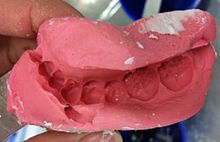
An impression torso, fabricated from alginate impression material.

A custom dental model or cast.
A dental impression is a negative imprint of difficult (teeth) and soft tissues in the rima oris from which a positive reproduction (bandage or model) tin be formed. It is made by placing an appropriate textile in a stock or custom dental impression tray which is designed to roughly fit over the dental arches. Impression material is of liquid or semi-solid nature when first mixed and placed in the mouth. It then sets to become an elastic solid (normally takes a few minutes depending upon the material), leaving an imprint of person'due south dentition and surrounding structures of oral crenel.
Uses [edit]
Impressions, and the report models, are used in several areas of dentistry including:
- diagnosis and treatment planning
- prosthodontics (such every bit making dentures)
- orthodontics
- restorative dentistry (e.g. to brand impressions of teeth which have been prepared to receive indirect extracoronal restorations such as crowns, bridges, inlays and onlays)

Wax mock upwardly of crowns on a cast made from an impression
- maxillofacial prosthetics (prosthetic rehabilitation of intra-oral and extra-oral defects due to trauma, congenital defects, and surgical resection of tumors)
- oral and maxillofacial surgery for both intra-oral and or extra-oral aims (east.thousand. dental implants)
The required type of material for taking an impression and the expanse that information technology covers will depend on the clinical indication. Mutual materials used for dental impressions are:[1]
- not rigid materials:
- reversible hydrocolloids: agar
- irreversible hydrocolloids: sodium alginate
- elastomeric materials:
- silicones (polyvinyl siloxane): condensation-cured silicones, add-on silicones, vinyl polyether silicones (VPES)
- polyethers
- polysulphides
- rigid materials:
- plaster of Paris
- impression chemical compound
- zinc oxide and eugenol-based impression paste
Techniques for taking impression [edit]
Impressions can also be described equally mucostatic or mucocompressive, existence defined both by the impression textile used and the blazon of impression tray used (i.e. spaced or closely adjusted). Mucostatic means that the impression is taken with the mucosa in its normal resting position. These impressions will generally atomic number 82 to a denture which has a proficient fit during rest, but during chewing, the denture volition tend to pin around incompressible areas (e.grand. torus palatinus) and dig into compressible areas. Mucocompressive ways that the impression is taken when the mucosa is subject to compression. These impressions will by and large lead to a denture that is most stable during function only not at rest. Dentures are at balance about of the fourth dimension, and then it could be argued that mucostatic impressions make better dentures, yet in reality it is likely that tissue adaption to the presence of either a denture fabricated with a mucostatic or a mucocompressive technique make footling difference betwixt the two in the long term. Another type of impression technique is selective pressure technique in which stress bearing areas are compressed and stress relief areas are relieved such that both the advantages of muco static and muco compressive techniques are achieved.
-
- User Guide of Dental Impression material: https://www.youtube.com/watch?v=-keGMbCHC2A
Special techniques [edit]
- "Launder impression" – this is a very thin layer of low viscosity impression cloth which is used to tape fine details. Commonly it is the 2nd stage, where the runny impression material is used afterward an initial impression taken with a more pasty cloth.
- Two phase one stage: the putty and low body weight impression materials are inserted to the rima oris at one time .
- Two stage two stage: beginning the putty is gear up in the mouth then low body weight cloth is added on the meridian of gear up impression and inserted to the mouth to get the concluding authentic impression
- Functional impression (also known every bit secondary impression)
- Neutral zone impression
- Window technique
- Contradistinct bandage technique
- Applegate technique
Impression for provision of stock-still prosthesis [edit]
When taking impression for provision of crown and span work, the training border needs to be accurately captured by the lite bodied impression material. For this reason, the gingival tissues need to be pushed abroad from the preparation margin in order to go far accessible to the impression material. One style to retract gingival tissues away from the molar is by insertion of a retraction string into the gingival crack.[ii]
Impression materials [edit]
Impression materials tin can be considered equally follows:
Rigid [edit]
Plaster of Paris (impression plaster) [edit]
Plaster of Paris is traditionally used equally a casting textile once the impression has been taken, however its use every bit an impression cloth is occasionally useful in edentate patients.[3] The tissues are not displaced during impression taking, hence the material is termed mucostatic. Mainly composed of β-calcium sulphate hemihydrate, impression plaster has a similar composition and setting reaction to the casting fabric with an increase in certain components to control the initial expansion that is observed with Plaster of Paris. Additionally, more h2o is added to the pulverisation than with the casting material to aid in good menstruum during impression taking. As the impression material is very similar to the casting cloth to be used, information technology requires the incorporation of a separating medium (due east.g. sodium alginate) to aid in separating the cast from the impression. If a special tray is to exist used, impression plaster requires 1–1.5mm spacing for adequate thickness.
Advantages:[3]
- Hydrophilic
- Good detail reproduction
- Skillful dimensional stability (wrinkle on setting)
- Skilful patient tolerance
- ii–3 minutes working fourth dimension
Disadvantages:[3]
- Brittle
- No recovery from deformation. Therefore, if an undercut is nowadays the material will have to be cleaved off the impression and so glued back together prior to casting
- Excess salivation by the patient could have adverse effect on item reproduction
Impression compound [edit]
Impression compound has been used for many years every bit an impression textile for removable prostheses. Although its use has recently declined with the appearance of better materials. Due to its poor flow characteristics, it is unable to reproduce fine particular and then its use is somewhat limited to the following scenarios:
- Primary impressions of complete dentures
- Edge moulding of trays
- Extension of trays
- Achieving mucocompression in the mail-dam expanse when working impressions are taken for consummate dentures
Impression chemical compound is a thermoplastic material; it is presented every bit a sheet of fabric, which is warmed in hot water (> 55–60 °C) for one minute, and loaded on a tray prior to impression taking. Once in the mouth, the fabric volition harden and record the detail of the soft tissues. The impression can further exist hardened by placing information technology in common cold water later on employ. Impressions with compound should be poured inside an hour every bit the material exhibits poor dimensional stability. There are two main presentations of impression compound: ruby chemical compound and greenstick. The latter is mainly used for border moulding and recording the postal service-dam area.
Vinyl polysiloxane impression material (impression material) [edit]
vinyl polysiloxane dental impression materials used for making accurate dental impressions with splendid reproducibility. It is available in Putty and light body consistencies to help dentists make perfect impressions for fabrication of crowns, bridges, inlays, onlays and veneers. Case Flexceed
Advantages:
- Better reproduction detail with two viscosities (Putty & Light Body)
- Exhibits pseudo-plastic backdrop for precision which is not constitute in alginates
- Superior tear force than whatsoever other VPS material
- Better dimensional stability – multiple models can exist poured upwardly to 2 weeks
- Good hydrophilicity
- Compatible with gypsum products
- Superior wetting characteristics ensuring gypsum working cast is difficult with smoothen surface
- Can be subjected to common cold sterilization without compromising the details and dimensional stability of the impression
Zinc-oxide eugenol plaster (impression paste) [edit]
Impression paste is traditionally used to take the working (secondary) impressions for a complete denture. When used with a special tray it requires i mm of spacing to allow for enough thickness of the fabric; this is also termed a shut fitting special tray.[3] It is available as a ii-paste system:
- Base of operations paste: zinc oxide
- Catalyst paste: eugenol
The two pastes should be used in equal amounts and composite together with a stainless steel spatula (Clarident spatula) on a newspaper pad. Zinc-oxide Eugenol plaster will produce a mucostatic impression.
Advantages:[iii]
- Thermoplastic – tin can be heated to assist removal from the casting textile
- Good detail reproduction
- Good dimensional stability (0.xv% shrinkage on setting)
Disadvantages:[3]
- Rigid – presence of undercuts tin distort the final material or crusade the section engaged to separate from resultant impression
Impression waxes [edit]
Non rigid [edit]
Hydrocolloid [edit]
Agar [edit]
Agar is a fabric which provides high accuracy. Therefore, it is used in stock-still prosthodontics (crowns, bridges) or when a dental model has to be duplicated by a dental technician. Agar is a true hydrophilic material, hence the teeth do non need to be dried before placing information technology into the mouth.[1] Information technology is a reversible hydrocolloid which ways that its physical land can be changed by altering its temperature which allows to reuse the material multiple times. The material comes in form of tubes or cartridges. A special hardware is required in the process of taking agar impressions, namely a water bath and rim lock trays with coiled edges allowing passage of cold water for cooling the fabric to set while in the oral cavity. The bath consists of three containers filled with water at unlike temperatures: the get-go is set at 100 °C to liquefy the agar, the second is used to lower down the temperature of the cloth for safety intra-oral use (usually set at 43–46 °C) and the third 1 is used for storage and is gear up at 63–66 °C. The storage container tin can maintain agar tubes and cartridges at temperature 63–66 °C for several days for user-friendly immediate use. The tray is connected to a hose, cloth is loaded onto the tray and placed in the oral cavity over the preparation – an adequate thickness of the textile is required, otherwise distortion may occur upon removal from the mouth. The other stop of the hose is connected to a cold water source. The hydrocolloid is so cooled downwardly through the tray wall which results in setting of the cloth. The models should be poured as soon as possible to avoid changes in dimensional stability.[1]
Modern dentistry offers other materials (e.g. elastomerics) which provide high accuracy impressions and are easier to apply hence agar is used less frequently.
Advantages:[i]
- high accuracy
- hydrophilic
- reusable
Disadvantages:[i]
- complex procedural steps
- significant start-up cost of the hardware
Alginate [edit]

Dental impression of upper teeth recorded by Alginate
Alginate, on the other hand, is an irreversible hydrocolloid. It exists in two phases: either equally a viscous liquid, or a solid gel, the transition generated past a chemical reaction.[4] The impression cloth is created through adding h2o to the powdered alginate which contains a mixture of sodium and potassium salts of alginic acrid. The overall setting double composition reaction is equally follows:
Potassium (sodium) alginate + calcium sulphate dihydrate + water → calcium alginate + potassium (sodium) sulphate
Sodium phosphate is added every bit a retarder which preferentially reacts with calcium ions to delay the set of the material.
Alginate has a mixing time of 45–60 secs, a working time of 45 secs (fast prepare) and 75 secs (regular ready). The setting fourth dimension tin can be between ane – 4.v mins which tin be varied by the temperature of water used: the libation the water, the slower the set and vice versa. Y'all want to ensure that the material is fully set before removal from the mouth.
The water content that the completed impression is exposed to must be controlled. Improper storage tin either result in syneresis (the material contracts upon standing and exudes liquid) or imbibition (water uptake which is uncontrolled in extent and management). Therefore, the impression must be stored correctly, which involves wrapping the set material in a damp tissue and storing it in a sealed polythene pocketbook until the impression can exist cast. Alginate is used in dental circumstances when less accuracy is required. For example, this includes the creation of study casts to programme dental cases and design prosthesis, and also to create the primary and working impressions for denture construction.
Several faults can exist encountered when using an alginate impression cloth, but these can generally be avoided through adequate mixing, correct spatulation, correct storage of the set material, and timely pouring of the impression.
Due to the increased accuracy of elastomers, they are recommended for taking secondary impressions over alginate. Patients both preferred the overall feel of having an impression taken with an elastomer than with alginate, and also favoured the resultant dentures produced.[v]
Advantages:
- Easy flow
- Cheap
- Reproduction of adequate item
- Fast setting time
- Minimal tissue displacement in the mouth
Disdavantages:
- It has poor dimensional stability
- Poor tear force
- If information technology is unsupported, it distorts
- Easy to include air during mixing
- A minimum thickness of 3 mm is required which is hard to achieve in sparse areas in betwixt the teeth
Non-aqueous elastomeric impression materials [edit]
As stated above, there are times clinically where the accurateness of an alginate impression is not acceptable, especially for the construction of fixed prosthodontics. Agar may exist used only as discussed has a number of technical difficulties in its use. As such elastomers were adult to capture the fine item and accuracy required.
Polysulphides [edit]
Polysulphides have become increasingly unpopular due to their unpleasant sense of taste/scent. The fabric is presented every bit a paste to paste system mixed past a dental nurse prior to utilize. The fabric sets past a condensation polymerisation reaction. Initially the polymer chains increase in length causing a slight increase in temperature, of 3–4 °C. This is so followed by cross linking of the polymer bondage and finally the release of h2o as a by production. This afterward reaction slightly contracts the material making it stiffer and more resistant to permanent deformation. When poured and cast this slight contraction means the resulting model is slightly larger and as such creates space for the luting cement.
Advantages:[three]
- Good tear resistance
- Dimensionally stable – some shrinkage on set with release of past-product
- Expert Accuracy
- Most flexible elastomer
Disadvantages:[3]
- Reduced patient satisfaction – distinct unpleasant taste and smell
- Long setting time
- Requires excellent moisture control
- Difficult to mix
Polyethers [edit]
Polyethers are the nigh hydrophilic impression material of the hydrophobic elastomers. This holding makes it a unremarkably used textile in general practice as it more likely to capture training margins when wet control is not perfect.
Presented as a paste to paste system the textile is oft used with a monophase impression technique, pregnant both the material syringed round the preparation and the bulk within the tray are the same material. Note when mixing polyether the base to accelerator ratio is not 1:1 like with most elastomers, but 1:4.
Advantages:[3]
- Most hydrophilic elastomeric impression material
- Dimensionally stable – minimal shrinkage on set with release of by-production
- Good accuracy
- Monophase impression
- Good tear resistance
Disadvantages:[3]
- Can exist too stiff – deep undercuts and space nether a span pontic should be blocked out with soft (modelling) wax to prevent inadvertently removing bridge with impression
Indications:
- Indirect bandage restorations, specially in cases where moisture control cannot exist guaranteed
- Locating and the pick up of implant analogues in training for placement of superstructure
- Functional impression taking in removable prosthodontics
Silicones [edit]

Impression taken with silicon
There are ii types of silicone impression material, improver and condensation (reflecting each of their setting reactions). Silicones are inherently hydrophobic and every bit such require first-class moisture control for optimal use.
Improver silicone [edit]
Addition silicones have get the most used impression material in advanced restorative dentistry. There are many forms available, based on their differing amounts of filler content. This dictates the menstruation properties of each blazon with more filler resulting in a thicker, less flowable material. The nigh common forms are: extra calorie-free-bodied (low filler content), light-bodied, universal or medium-bodied, heavy-bodied and putty (loftier filler content). Withal each type follows the same add-on polymerisation reaction and is presented as a paste to paste organization. The reaction does not produce any by-product making it dimensionally stable and very accurate.
Advantages:[iii]
- Proficient item reproduction
- Excellent dimensional stability – no shrinkage on set
- High patient acceptance
- More than one model can be poured from one bandage
Disadvantages:[3]
- Hydrophobic – requires excellent moisture command
- Too accurate – impression may not be compensated for during investment and casting, resulting in too small a die being produced and later on likewise small a restoration.
- Poor tear resistance
- Expensive
Indications:
- Indirect cast restorations
- Multiple models required
- Impressions for removable prosthodontics
- Bite registration material
Contraindications
- Inadequate moisture control
Condensation silicone [edit]
Condensation silicones are commonly used as a putty, paste or lite bodied material. The systems are unremarkably presented as a paste or putty and a liquid/paste catalyst; meaning accurate proportioning is difficult to attain resulting in varied outcomes. For case, the setting reaction of putty is started by kneading a low viscosity paste accelerator into a bulk of silicone with high filler content.
As stated the material sets by a condensation reaction forming a iii-dimensional silicone matrix whilst releasing ethyl alcohol as a by-product. This in turn results in a minimally exothermic set with marked shrinkage on setting (shrinkage existence relative to filler content, where high filler content has reduced shrinkage).
Advantages:[3]
- Accurate
- High patient acceptance
Disadvantages:[3]
- Hydrophobic – requires excellent wet control
- Unreliable dimensional stability – hard to accurately proportion components leading to variable results
- Marked shrinkage on setting with release of by-production
Indications:
- Indirect cast restorations
- Matrices for indirect/directly restoration
- Working impressions for metal based removable prosthodontics and relines
- Lab putty
Impression trays [edit]
An impression tray is a container which holds the impression material equally information technology sets, and supports the set impression until after casting. Impression trays can be separated into 2 main categories- stock trays and special trays.
Stock trays [edit]

Metal stock tray for upper jaw

Plastic stock trays of both jaws
Stock trays are used to accept chief impressions and come in a range of sizes and shapes, and tin be plastic or metal. Stock trays tin can be rounded (designed to fit the mouths of people with no remaining teeth) or squared (designed to fit people with some remaining teeth). They can be full arch, covering all the teeth in either the upper or lower jaw in one impression, or a partial coverage tray, designed to fit over about three teeth (used when making crowns). The stock tray with the closest size and shape to the patient's own curvation dimensions is selected for impressions.
Stock trays must encounter various requirements in lodge to obtain a satisfactory impression. A skillful stock tray will:
- Be rigid enough to endure the force of the dental impression cloth being positioned in the mouth. Flexure of the tray nether force would cause the tray to be distorted, then when the impression tray is removed the impression would be narrower and distorted. This is peculiarly important for plastic stock trays.
- Be of appropriate dimensions to obtain the nigh accurate impression of the region being reproduced possible. Inadequate extension of an impression tray where the impression textile is not supported would likely cause distortions in the impression of the surface area.
- Be loose enough around the dental arch to not touch the soft tissues of the mouth.
- Have a sturdy handle to allow the tray to be hands removed from the mouth.
- Exist easily disinfected, unless for unmarried use. Disposable trays are frequently preferred due to increasing legislation almost infection control in medicine and dentistry.
Stock trays can be dentate or edentulous, and perforated (used with alginate) or non-perforated (allows the impression material to run through the holes and increase the bond of the impression material to the tray when fix).
Plastic stock trays [edit]
Plastic stock trays are more often than not injection moulded from a high-touch styrene such as polystyrene. The Triple Tray is a type of plastic tray used for taking impressions for a crown using the double curvation or dual bite impression technique. It is used for taking impressions of the molar training and the opposing teeth, by the utilize of a special impression cloth, normally elastomer. The accurateness of the results is all the same subject area to the power of the patient to close their teeth when the tray is present in the mouth. It cannot produce results of the consummate arch, therefore its usefulness is limited.
Metal stock trays [edit]
Metal stock trays are often preferred over plastic stock trays, due to the lack of rigidity in plastic stock trays. Although expensive to purchase, they have the benefit of being reusable, so tin can exist more than price-efficient in the long-term.
Custom trays [edit]

A special tray is an impression tray custom made for an individual patient past a denturist (dental technician), usually made from acrylic, such every bit polymethyl methacrylate, or shellac. A stock tray is used to make a preliminary impression, from which a model tin be cast. This is and so used for wax to make the tray to be laid down. The thickness corresponds to specific spacing, and can be classed as spaced, where virtually 3mm of space is left between the tray and the mucosa for the impression material to occupy, or closely adjusted, where less space is left for the impression material. This is determined by the impression material to be used.
Specific features can be given to the special tray to amend the accurateness of the impression such as a window which can help to tape displaceable tissues such as flabby ridges when used with a less viscous impression fabric. Special trays tin be given perforations if required by drilling holes in tray.
Customised trays have been less oftentimes used since the advent of putties. This is due to the putty providing good support for low-cal bodied material, and showing very little dimensional change which provides a fine detailed dental impression. There is at present a big increment in the diverseness of stock trays available.
Tray adhesives [edit]
Tray adhesives are used to ensure the retention of the impression material in the impression tray, with or without the presence of perforations, and are based on contact adhesive engineering science. Maximum retention can be achieved with the presence of both a tray adhesive and perforations in the impression tray. The adhesive is applied to the internal surface of the tray, as well equally over the margins to ensure the binding of the outer edge of the impression cloth to the tray. A suitable corporeality of adhesive (usually two thin coats) should exist applied to the tray to prevent pooling of the adhesive which can weaken the bond between the tray and impression material. The agglutinative should be completely stale prior to impression-taking. Tray adhesives unremarkably come in a screw-acme bottle with a castor fastened to the lid that tin be used for applying the agglutinative. Overtime, the agglutinative can accrue around the cap, causing the evaporation of the solvent, and consequently the thickening of the adhesive. This can reduce the efficacy of the adhesive to bind to the tray.
Types [edit]
Various tray adhesives are available, corresponding to the impression material used.
| Impression material | Adhesive used |
|---|---|
| Polyether | Ethyl acetate dissolved in propanol or acetone |
| Polysulphide | Styrene acrylonite or butyl condom dissolved in a ketone or in chloroform |
| Alginate | 10–12% toluene dissolved in 45–fifty% isopropanol |
| Condensation silicone | Ethyl silicate (bonds to tray) and poly dimethyl silicone (reacts with impression material) |
| Addition silicone | Ethyl silicate (bonds to tray) and poly dimethyl silicone (reacts with impression material), frequently with the addition of naphtha and ethyl acetate |
Digital impressions [edit]
Digital impressions using scanner systems are being adopted in dentistry. They produce a model by milling or stereolithography which is used after.[7] [eight]
References [edit]
- ^ a b c d e J., Bonsor, Stephen (2013). A clinical guide to applied dental materials. Pearson, Gavin J. Amsterdam: Elsevier/Churchill Livingstone. pp. 243–251. ISBN9780702031588. OCLC 824491168.
- ^ John F. McCabe, Angus W. G. Walls (1990). Applied Dental Materials. Wiley. p. 143. ISBN978-i-118-69712-2.
- ^ a b c d e f grand h i j yard l m n Stephen J. Bonsor, Gavin J. Pearson (2013). A Clinical Guide to Applied Dental Materials. United Kingdom: Elsevier. pp. 237–273. ISBN978-0-7020-3158-viii.
- ^ Bonsor, Stephen J.; Pearson, Gavin J. (2013). A clinical guide to applied dental materials. Elsevier/Churchill Livingstone. pp. 245–248. ISBN9780702031588.
- ^ Hyde, T.P; Craddock, H.L; Gray, J.C; Pavitt, S.H; Hulme, C; Godfrey, M; Fernandez, C; Navarro-Coy, Due north; Dillon, S; Wright, J; Dark-brown, S; Dukanovic, G; Brunton, P.A (2013). "A Randomised Controlled Trial of complete denture impression materials". Journal of Dentistry. 42 (8): 895–901. doi:ten.1016/j.jdent.2014.02.005. PMC4119301. PMID 24995473.
- ^ Bonsor, Stephen, J., Pearson, Gavin, J. (2013). A clinical guide to applied dental materials. Elsevier/Churchill Livingstone. pp. 238-242. ISBN 9780702031588.
- ^ "Why Digital Impressions?". world wide web.dentaleconomics.com . Retrieved 2019-01-06 .
- ^ Flügge, Tabea V.; Schlager, Stefan; Nelson, Katja; Nahles, Susanne; Metzger, Marc C. (2013-09-01). "Precision of intraoral digital dental impressions with iTero and extraoral digitization with the iTero and a model scanner". American Periodical of Orthodontics and Dentofacial Orthopedics. 144 (3): 471–478. doi:x.1016/j.ajodo.2013.04.017. ISSN 0889-5406. PMID 23992820.
Source: https://en.wikipedia.org/wiki/Dental_impression

Posting Komentar untuk "what type of wax could be used to form a wall around a preliminary impression when pouring it up?"