Get a 1956 Chevy Belair Running Again
| Chevrolet Bel Air | |
|---|---|
 1957 Chevrolet Bel Air Convertible | |
| Overview | |
| Manufacturer | Chevrolet (General Motors) |
| Production | 1949–1980 |
| Model years | 1950–1981 |
| Body and chassis | |
| Class | Total-size Musculus car |
| Layout | FR layout |
| Chronology | |
| Predecessor | Chevrolet Fleetline |
| Successor | Chevrolet Impala |
The Chevrolet Bel Air is a full-size motorcar that was produced by Chevrolet for the 1950–1975 model years. Initially, only the two-door hardtops in the Chevrolet model range were designated with the Bel Air name from 1950 to 1952. With the 1953 model year, the Bel Air name was changed from a designation for a unique torso shape to a premium level of trim practical across a number of trunk styles. The Bel Air continued with various other trim level designations, and it went from a mid-level trim automobile to a budget fleet sedan when U.S. production ceased in 1975. Product connected in Canada, for its home market only, through the 1981 model yr.
The Chevrolet Bel Air, especially its 3rd generation design, has been considered an icon of the 1950s. Well-maintained and preserved examples are highly sought afterward by machine collectors and enthusiasts.
History [edit]
First generation (1950–1954) [edit]
| Showtime generation | |
|---|---|
 1951 Chevrolet Bel Air | |
| Overview | |
| Product | 1949–1954 |
| Model years | 1950–1954 |
| Associates | (main factory) Flint, Michigan, (Flintstone Associates) (co-operative assembly) S Gate, California, (Due south Gate Assembly) Tarrytown, New York, (North Tarrytown Assembly) Lakewood Heights, Georgia, (Lakewood Assembly) St. Louis, Missouri, (St. Louis Assembly) Oakland, California, (Oakland Assembly) Norwood, Ohio, (Norwood Assembly) |
| Body and chassis | |
| Body style | 2-door hardtop ii-door coupe (1953–54) iv-door sedan (1953–54) 2-door convertible (1953–54) four-door station wagon (1954) |
| Platform | GM A Body |
| Related | Pontiac Star Main |
| Powertrain | |
| Engine | 216.five cu in (3.v L) "Thriftmaster" 1-bbl. valve-in-head 92 hp I6[i] 235.5 cu in (3.9 Fifty) Blue Flame I6 |
| Transmission | 3-speed manual ii-speed powerglide automobile. |
| Dimensions | |
| Wheelbase | 115"[1] |
| Length | 197.v"(1950–1952);[1] [two] fifteen"(1954)[one] |
| Curb weight | 3,345[3] |
From 1950 to 1952, the Bel Air Sport Coupe name was used just for the 2-door hardtops in the Chevrolet model range, to distinguish the auto from the Styleline and Fleetline models. It was named for the wealthy Bel Air neighborhood on the Westside of Los Angeles.
Beginning year production reached only 76,662 models congenital. The car cost $1,741 and weighed 3,225 lb (one,463 kg).[4] Front end intermission was contained, named "knee-action".[two] The first Bel Airs of this era shared only their front sheet metallic alee of the A pillar with the balance of the range. The windshield, doors, glass, and torso were common with the Styline Palatial Convertible Coupe, however the roof, rear quarters and rear windows (3) were unique. The chassis and mechanicals were common with the residue of the passenger car range, and the overall appearance was the aforementioned equally the rest of the range, except that the roof line was lower and the unique three piece rear window gave it a longer and more counterbalanced look. The first Bel Airs were available with only the "Palatial" premium trim level and specification.
Apart from the usual annual grille and trim changes, the 1951–1952 Bel Air differed from the earlier 1950 model with introduction of the college and squarer rear guards that were across the whole range.
In 1953 Chevrolet renamed its series, and the Bel Air proper noun was practical to the premium model range. Two lower series, the 150 and 210, also emerged (as successors to the Special and Deluxe series, respectively). The 1953 Chevrolet was advertised as "Entirely new through and through," due to the restyled trunk panels, front and rear ends. However, essentially these Chevrolets had similar frame and mechanicals to the 1949–1952 cars.
The Bel Air was given a facelift in 1953. The pre-war technology, such as torque tube bulldoze, half dozen-cylinder splash feed engines, knee-action break, and split windshields of the early models was phased out and the foundations for the first post war modern Chevrolet rider car were finalized. The Bel Air series featured a wide chrome strip of molding from the rear fender bulge to the rear bumper. The inside of this stripe was painted a analogous color with the exterior body color, and "Bel Air" scripts were added inside the strip. Lesser models had no model designation anywhere on the car, having only a Chevy crest on the hood and body. 1953 was the first yr for a curved, one-piece windshield.[ane] [5]
In the July 1953 issue of Popular Mechanics, a tested 1953 Bel Air went from 0-60 mph in 19.6 seconds.[vi]
Bel Air interiors had an optional massive surface area of chrome across the lower part of the dashboard (most were painted), along with a deluxe Bel Air steering wheel with full chrome horn band. Carpeting and full wheel covers rounded out Bel Air standard equipment. For 1954, the Bel Air stayed essentially the same, except for a revised grille and taillights, and a revised engine that had insert bearings and higher oil pressure, needed for the full-flow oil filtration organisation that was not available prior to 1954. Prior to 1954, the 235 and 216 cubic inch vi cylinder engines had babbit bearings and scoops to create oil pressure level at the bottom of each rod and the oil pressure was standard at 15-30 PSI. During these years, in that location were three engine choices, depending on the transmission ordered. Both 235 cubic inch engines were "Blue Flame" inline six cylinder OHV engines, featuring hydraulic valve lifters (in 1953 with automatic transmissions) and aluminum pistons. The 106 hp (79 kW) 235 cubic inch deportation engine was standard on stickshift models, with solid lifters and splash plus pressure lubrication including babbit bearings. Powerglide cars got a 115 hp (86 kW) version which had hydraulic lifters and full pressure lubrication.
In 1953 and 1954, Bel Airs could be ordered in convertible, hardtop coupe, two- and 4-door sedans, and, for 1954, the Beauville station wagon which featured woodgrain trim effectually the side windows. Many new options, one time available only to more expensive luxury cars, became offered starting in 1953, including power steering and the Guidematic headlight dimmer in 1953; and ability brakes, power 2-way front seat and power front windows in 1954. All 1954 models equipped with the standard transmission used the 1953 Powerglide engine.
-
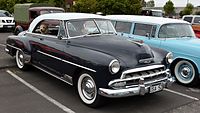
1952 Chevrolet Bel Air
-
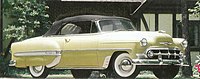
1953 Chevrolet Bel Air Convertible
-

1954 Chevrolet Bel Air Sport Coupe
Second generation (1955–1957) [edit]
| 2nd generation | |
|---|---|
 1955 Chevrolet Bel Air convertible | |
| Overview | |
| Production | 1954–1957 |
| Model years | 1955–1957 |
| Assembly | (chief found) Flint, Michigan, (Flintstone Assembly) (branch assembly) Caracas, Venezuela[7] Oshawa, Ontario, Canada (Oshawa Car Assembly) Arlington, Texas, (Arlington Associates) S Gate, California, (South Gate Assembly) Baltimore, Maryland, (Baltimore Assembly) |
| Designer | Bill Mitchell |
| Body and chassis | |
| Class | Full-size |
| Body style | two-door hardtop 4-door hardtop (1956–57) 4-door sedan 2-door convertible 2-door Station wagon four-door station wagon |
| Layout | FR layout |
| Platform | GM A Body |
| Related | Chevrolet 210 Chevrolet 150 Chevrolet Nomad Pontiac Chieftain |
| Powertrain | |
| Engine | 216.five cu in (3.five L) Thriftmaster I6 235.five cu in (iii.9 Fifty) Blue Flame I6 265 cu in (4.3 50) Minor-Block V8 283 cu in (iv.6 L) Minor-Cake V8 (1957) |
| Manual | 3-speed manual[8] 2-speed Powerglide machine. 3-speed Turboglide machine. |
| Dimensions | |
| Wheelbase | 115"[9] |
| Length | 195.6" |

The Bel Air received new, revamped styling for the 1955 model year. The Bel Air was three,456 lb (ane,568 kg) and 15 ft (4.6 m) long. It was chosen the "Hot Ane" in GM'south advertisement entrada. Bel Airs came with features plant on cars in the lower models ranges plus interior carpet, chrome headliner bands on hardtops, chrome spears on front fenders, stainless steel window moldings,[1] full wheel covers, and a Ferrari-inspired front grille. Models were further distinguished by the Bel Air name script in gold lettering later on in the year.[9] For 1955 Chevrolets gained a V8 engine choice and the selection of the 2 speed Powerglide automatic, or a standard 3 speed Synchro-Mesh manual transmission with optional overdrive. The new 265 cu in (4.iii L) V8 featured a modern, overhead valve high pinch ratio, short stroke design that was and so skillful that it remained in production in various displacements for many decades. The base V8 had a 2-barrel carburetor and was rated at 162 hp (121 kW) and the "Ability Pack" option featured a four-barrel carburetor and other upgrades yielding 180 bhp (134 kW). Later in the year, a "Super Ability Pack" choice added high-compression and a further 15 bhp (11 kW). Warning lights replaced gauges for the generator and oil force per unit area.[10] This was not the get-go Chevrolet to be installed with a V8 engine; the outset Chevrolet with a V8 engine was introduced in 1917 and called the Series D, which was built for two years, and was manufactured earlier Chevrolet joined General Motors.
The 1955 Bel Air was very well received. Motor Trend magazine gave the Bel Air height marks for handling.[x] Pop Mechanics reported acceleration for a V8 Bel Air with Powerglide as beingness 0-lx mph (97 km/h) in 12.9 seconds, plus a comfortable ride and good visibility. On the other hand, the horn ring blocked some of the speedometer, regular gasoline made the engine knock and the kickoff V8 engines off the line burned too much oil.[11] Front legroom was 43.1".[i] Brakes were 11" drums.[12] A new option for V8-equipped 1955 models was air conditioning, with outlets on each side of the dashboard; a heavy-duty generator was included on cars equipped with this option; in 1955 and 1956, air conditioning could exist installed on cars ordered with the standard iii-speed manual transmission, overdrive or Powerglide, simply from 1957 onward, an automated transmission (or minus that, 4-speed transmission transmission) was a pre-requisite option.
The 1956 Bel Air received a confront-lift with a more conventional full-width grille, pleasing those customers who didn't favor the Ferrari-inspired '55 front end end. Ii-tone bodyside treatments and front and rear wheel openings completed the "speedline" restyling. Single housings incorporated the taillight, stoplight, and backup light, and the left one held the gas filler - an idea popularized on Cadillacs. Amid the seven Bel Air models was a new Sport Sedan, a pillarless 4-door hardtop that looked handsome with all the windows rolled down and allowed easy entry into the dorsum seat. Production exceeded 103,000, compared to 128,000 ii-door hardtops. Shapely two-door Nomad wagons topped the price chart at United states$2,608 ($24,825 in 2022 dollars [thirteen]), but at present carried the same interior and rear-bike sheetmetal as other Bel Airs, defective the original'due south unique trim. Merely 7,886 were built. The least costly Bel Air, at US$2,025 ($19,276 in 2022 dollars [xiii]), was the 2-door sedan. Seatbelts, shoulder harnesses, and a padded dashboard were bachelor,[10] and total-size cars could even go the hot Corvette 225-horsepower engine. In 1956 sales textile there was an optional rain-sensing automated acme,[fourteen] which was first seen on the 1951 LaSabre concept car. However, it is believed that it was never installed on a car.[xv] Popular Mechanics reported only 7.4% of owners in their survey ordered seat belts. A '56 Bel Air four-door hardtop, prepared by Chevy engineer Zora Arkus Duntov, fix a new endurance/speed tape for an automobile ascending Pikes Elevation.
In 1957 engine displacement grew to 283 cu in (4.6 L) with the "Super Turbo Burn V8" option (shared with the Corvette), producing 283 hp (287 PS; 211 kW) @ 6200 rpm and 290 lb⋅ft (393 Northward⋅m) @ 4400 rpm of torque[16] with the help of Rochester Ramjet[17] continuous mechanical fuel injection (closed-loop).[18] These and so-chosen "fuelie" cars are quite rare, since nigh Bel Airs were fitted with carburetion.
The 1957 Bel Air is considered past many to be "an icon of its age. . .correct aslope Elvis, Marilyn Monroe, and Leave information technology to Beaver," and is amidst the most recognizable American cars of all time;[nineteen] well-maintained examples, peculiarly sport coupes and convertibles are highly sought later on by collectors and enthusiasts. They are roomy, with tastefully restrained, flow use tail fins and chrome. A second automatic transmission, Turboglide was optional. While the original two-speed Powerglide continued unchanged, Turboglide provided a continuously variable gear-ratio which made "shifting" imperceptible. The shift quadrant on Turboglide cars followed a "P R Due north D Gr" pattern.[20] [21]
From 1955 to 1957, production of the two-door Nomad station wagon was assigned to the Bel Air serial, although its body and trim were unique to that model. Prior to becoming a regular production model, the Nomad first appeared equally a Corvette-based concept vehicle in 1954. Chevrolet has since unveiled 2 concept cars bearing the Nomad proper name, about recently in 1999. The 1955–1957 Chevrolets are commonly referred to as Tri Fives.
The 1955-1957s were made in right-manus drive and shipped from Oshawa Motorcar Assembly in Oshawa, Ontario, for local assembly in Australia (CKD), New Zealand (SKD) and Southward Africa. All three model years had a reversed version of the '55 LHD dashboard and did non become the LHD models' 1957 redesign.
A black 1955 Chevrolet Bel Air was featured in the 1973 movie American Graffiti. The 55" features a big hood scoop, and a signature cowboy hat in the rear window. In the moving-picture show, it races against a xanthous 1932 Ford Deuce Coupe and crashes into a ditch. The Bel Air had a 454 cubic inch chevrolet motor, with aluminum heads, tunnel ram intake and dual Holley carburetors.
-

1955 Chevrolet Bel Air ii-door Hardtop
-
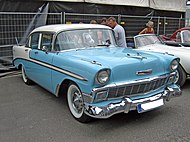
1956 Chevrolet Bel Air 4-door Sedan
-

1957 Chevrolet Bel Air sport sedan
-
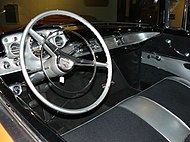
1957 Chevrolet Bel Air interior
Third generation (1958) [edit]
| Tertiary generation | |
|---|---|
 1958 Chevrolet Bel Air Coupe | |
| Overview | |
| Production | 1957–1958 |
| Model years | 1958 |
| Assembly | (chief plant) Flint, Michigan, (Flint Assembly (branch associates) Arlington, Texas, U.Southward.) South Gate, California, (S Gate Assembly) Baltimore, Maryland, (Baltimore Assembly) Oshawa, Ontario, Canada (Oshawa Car Associates) |
| Body and chassis | |
| Body style | two-door sedan two-door hardtop iv-door sedan four-door hardtop two-door convertible |
| Platform | GM B platform |
| Related | 1958 Chevrolet Delray 1958 Chevrolet Biscayne 1958 Chevrolet Impala 1958 Chevrolet Yeoman 1958 Chevrolet Brookwood 1958 Chevrolet Nomad |
| Powertrain | |
| Engine | 235.5 cu in (3.ix Fifty) 145 hp Blue Flame I6 283 cu in (iv.6 Fifty) Small-Cake V8 348 cu in (v.7 50) Big-Block 250–315 hp V8[1] |
| Manual | iii-speed manual 2-speed Powerglide car. |
| Dimensions | |
| Wheelbase | 117.5" [22] |
| Length | 209.one"[1] |
| Peak | 57.one"[23] |
For 1958, Chevrolet models were redesigned longer, lower, and heavier than their 1957 predecessors, and the 348 cu in (v.7 50) was now an option. The Bel Air gained a halo vehicle in 1958, the Impala, available only as a hardtop coupe and convertible in its introductory year. Impala styling followed the bones lines of the other Chevrolet models but received special styling cues including a different roof line, a vent above the rear window, unique side trim, and triple tail lights housed in slightly broader alcoves. 2 significantly cheaper models, the Biscayne (formerly the 210) and the Delray (formerly the 150) were also available during this model twelvemonth.
Chevrolet'south pattern for the year fared better than its other GM offerings, and lacked the overabundance of chrome found on other sedans at the time. Complementing Chevrolet's front pattern was a wide grille and quad headlights; the tail received a fan-shaped apse on both side panels, which housed dual tail lights. Despite being a recession year, consumers fabricated Chevrolet the No. 1 make of machine, and the Bel Air was at the core of Chevrolet'southward popularity. With its wide variety of body styles and models, Bel Airs could be optioned with almost every believable luxury within the Chevrolet line. The Nomad station wagon proper noun also reappeared in 1958 when the vehicle bowed every bit the premium four-door Chevrolet station wagon, lacking the unique styling of the 1955-57 Nomads. Almost Chevrolet station wagon models had two tail lights (one on each side of the torso) housed in abbreviated alcoves, which were made smaller to accommodate the rear gate. A new dash was used.[24]
Safety [edit]
The 1958 Bel Air featured Chevrolet's new "Safety-Girder" cruciform frame. Similar in layout to the frame adopted for the 1957 Cadillac, it featured box-section side rails and a boxed front cantankerous member that bowed under the engine. These "x-frames" were used on other 1958 to 1964 Chevys, as well as Cadillac. The rear was tied together by a channel-department cantankerous member.[25] This pattern was later criticized as providing less protection in the outcome of a side impact standoff, but would persevere until 1965.
For the commencement time, Powerglide models featured the "PRNDL" transmission selector arrangement, replacing the oft-criticized "PNDLR" quadrant that many considered confusing at all-time, dangerous at worst.
4th generation (1959–1960) [edit]
| Quaternary generation | |
|---|---|
 1959 Chevrolet Bel Air four-Door Sedan | |
| Overview | |
| Production | 1958–1960 |
| Model years | 1959–1960 |
| Assembly | (main constitute) Flintstone, Michigan, (Flint Assembly) (branch assembly) Arlington, Texas, U.S. South Gate, California, (Southward Gate Assembly) Baltimore, Maryland, (Baltimore Assembly) Oshawa, Ontario, Canada (Oshawa Car Associates) |
| Body and chassis | |
| Body style | two-door sedan two-door hardtop (1960) four-door sedan 4-door hardtop |
| Platform | GM B platform |
| Related | 1959–1960 Chevrolet Biscayne 1959–1960 Chevrolet Impala 1959–1960 Chevrolet Brookwood 1959–1960 Chevrolet Parkwood 1959–1960 Chevrolet Kingswood 1959–1960 Chevrolet Nomad 1959–1960 Chevrolet El Camino |
| Powertrain | |
| Engine | 235.v cu in (iii.ix L) Blue Flame I6 283 cu in (4.half dozen L) Pocket-size-Block V8 348 cu in (5.7 L) Big-Block V8 |
| Manual | three-speed transmission[1] 4-speed manual 2-speed Powerglide automobile. |
| Dimensions | |
| Wheelbase | 119"[1] |
| Length | 210.9"[ane] |
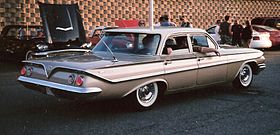
The Bel Air received a major redesign for the 1959 model year. The near visual new change was the flat, wing shaped tailfins.[ane] The machine was built on a 119 in (iii,000 mm) wheelbase and was 211 in (5,400 mm) long-which was 11 in (280 mm) longer than the 1957 model. This made Chevrolet the longest auto in the low-priced range, whereas ii years before information technology had been the shortest. In improver, the car was iii in (76 mm) wider outside and had 5 in (130 mm) more width inside than information technology did in 1958, through the reduction of door thickness. The "X" frame from 1958 was connected, but enlarged and strengthened to support the new body.[26]
The Bel Air, which had been the top line serial since 1953, was now the eye range. Wagons were still classed by themselves, merely had model numbers matching the car serial. Parkwood 6-passenger and Kingswood 9-passenger wagons had Bel Air's model number, and equally such were the eye range wagons. Nether the hood, trivial change took place. A multifariousness of speed options, such every bit fuel injection, special cams and lowered compression, gave horsepower ratings up to 315. Bel Air production was 447,100. The new Impala line surpassed Bel Air production by 20,000 units. A parking brake alarm calorie-free was optional.[27]
Little change was made for 1960. The new models were refinements of the 1959 style with a much more restrained front, the return of the double cone tail lights of 1958 rather than the startling "cat's eyes" of 1959. Under the hood, things remained constant. Fuel injection was no longer available, but with the 348 cubic inch engine, a horsepower rating of 335 at 5800 rpm was at present achieved. This involved the apply of three double-barrel carburetors, a special cam and an xi.25:1 compression ratio, all sold every bit a bundle. Torso way offerings followed 1959, with hardtops and sedans available. The convertible was reserved for the Impala serial. The Bel Air Sport Sedan continued to utilize a rear window overhang and a huge wraparound rear window. Bel Arrogance (and Biscaynes) had two tail lights per side; the Impalas had three tail lights per side—a situation that would persist for most years through 1975. Many of the same options and accessories that were available on the Impala were as well available on the Bel Air. The Bel Arrogance had more interior and outside brightwork than the Biscayne.
-

The special rear pattern of a 1959 Bel Air, here a 2-door Sedan
-

1960 Chevrolet Bel Air 4-door Sedan
Fifth generation (1961–1964) [edit]
| 5th generation | |
|---|---|
 1961 Chevrolet Bel Air four-Door Sedan | |
| Overview | |
| Product | 1960–1964 |
| Model years | 1961–1964 |
| Associates | (main establish) Flint, Michigan, (Flint Assembly) (branch assembly) Arlington, Texas, U.Due south. South Gate, California, (South Gate Assembly) Baltimore, Maryland, (Baltimore Assembly) Oshawa, Ontario, Canada (Oshawa Machine Associates) |
| Body and chassis | |
| Trunk style | 2-door sedan 2-door Hardtop (1961–62) 4-door sedan 4-door wagon (1962–64) four-door Hardtop (61) |
| Platform | GM B platform |
| Related | Chevrolet Biscayne Chevrolet Impala |
| Powertrain | |
| Engine | 230 cu in (three.viii L) Turbo-Thrift I6 235.5 cu in (3.9 50) Chevrolet I6 283 cu in (4.6 50) Small-Cake V8 327 cu in (5.iv Fifty) Pocket-size-Cake V8 348 cu in (five.7 L) Big-Block V8 409 cu in (half-dozen.vii L) Big-Block V8 |
| Transmission | 3-speed manual 4-speed manual 2-speed Powerglide auto. |
For 1961, the Bel Air received a new body. Its wheelbase remained 119 in (3,000 mm), but its length was now reduced slightly to 209.three in (five,320 mm). All engines options of the previous year remained in effect with the standard engines being the 235.5 CID Six of 135 hp (101 kW) or the 283 CID V8 of 170 hp (130 kW). The V8 toll $110 more than the Half-dozen and weighed 5 lb (2.three kg) less.
The Bel Air 2-door sedan used squared-off roof styling and large wrap-around rear window as opposed to the hardtop's swept-dorsum blueprint. The Bel Air 4-door Sport Hardtop however used a different roof line than did the iv-door sedan.
For 1962, all sheet metallic except the door panels was inverse. Overall length was stretched slightly to 209.six in (5,320 mm). The 4-door Sport Hardtop was no longer offered in the Bel Air series. Standard engines remained the same as the previous year. A new 327 cu in (five,360 cc) V8 of 250 or 300 hp (220 kW) was offered in addition to the giant (for the time) 409 cu in (6.seventy l) V8 of 380 hp (280 kW) or 409 hp (305 kW) with the dual four-barrel carburetor setup. All wagons this year were 4-door models and dissever distinctions for wagons were dropped. Now all models were either Biscayne, Bel Air or Impala series. Full rug returned as standard equipment on all 1962 Bel Air models for the first fourth dimension in several years. The Bel Air Sport Coupe was in its last yr of U.S. product, and its roofline was a carryover from the 1961 hardtop coupe.
The Bel Air was given a facelift in 1963. Its overall length increased to 210.iv in (5,340 mm). Replacing the older 235 cubic-inch half dozen-cylinder engine as standard equipment was a new 230 cubic-inch half dozen-cylinder of more modernistic blueprint with a 140-horsepower rating that was based on the 194 cubic-inch half dozen introduced on the compact Chevy Two Nova the previous year. The base V8 remained the 283 CID, which was upgraded to produce 195 hp (145 kW). The 409 CID V8 was at present offered in 340, 400 and 425 hp (317 kW) versions, while the small cake 327 V8 continued with options of 250 and 300 horsepower. The Bel Air continued to be Chevrolet's eye range, but it now consisted of only 2 car models- the 2-door sedan and the 4-door sedan. half-dozen and 9-passenger Bel Air station wagons were again offered.
For 1964, very few changes were made except the expected sheet metallic and trim renovations. Cars were 209.9 in (5,330 mm) in length while the wagons were 210.viii in (v,350 mm) long. In add-on to the un-changed standard engines, at that place were two different 327 CID engines were offered, developing from 250 hp (190 kW) to 300 hp (220 kW) and 3 409 CID engines ranging from 340 hp (250 kW) to 425 hp (317 kW). Except for a chrome belt line and $100 divergence in cost in that location was niggling outside difference betwixt the Bel Air and Biscayne version.
RHD Bel Airs continued to be imported into Australia. Some of these cars featured a reversed 1961 Pontiac instrument panel, but others had a mirror image of the more attractive current North American panel. Even more curious was the fact that some of these Bel Arrogance featured Impala-style triple taillights; the centre lens was bister in keeping with Australian legal standards.
-

1961 Chevrolet Bel Air four-Door Sedan
-

1964 Chevrolet Bel Air 2-Door Sedan
Sixth generation (1965–1970) [edit]
| Sixth generation | |
|---|---|
 1965 Chevrolet Bel Air ii-door Sedan | |
| Overview | |
| Production | 1964–1970 |
| Model years | 1965–1970 |
| Associates | (primary plant) Flintstone, Michigan, (Flint Assembly) (branch assembly) Arlington, Texas Doraville, Georgia, (Doraville Assembly) South Gate, California, (South Gate Assembly) U.S. Baltimore, Maryland, (Baltimore Assembly) U.South. Oshawa, Ontario, Canada (Oshawa Machine Assembly) |
| Torso and chassis | |
| Trunk fashion | two-door sedan (1965–69) iv-door sedan 4-door wagon (1965–69) |
| Platform | GM B platform |
| Related | Chevrolet Biscayne Chevrolet Impala Chevrolet Caprice |
| Powertrain | |
| Engine | 230 cu in (3.viii L) Turbo-Thrift I6 250 cu in (4.i 50) Turbo-Thrift I6 283 cu in (4.6 L) Small-Cake V8 307 cu in (5.0 50) Pocket-size-Block V8 327 cu in (5.4 L) Small-Block V8 350 cu in (five.seven L) Small-scale-Block V8 396 cu in (6.5 Fifty) Big-Cake V8 400 cu in (half dozen.6 50) Small-Cake V8 409 cu in (6.7 L) Large-Block V8 427 cu in (7.0 L) Big-Block V8 |
| Transmission | 3-speed manual iv-speed manual 2-speed Powerglide auto. three-speed Turbo Hydramatic auto. |
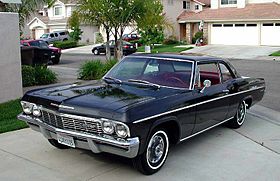
For 1965, the full size Chevrolet was totally restyled, and the cars were stretched to 213.3 in (5,420 mm) overall, fifty-fifty though the wheelbase remained the same. The new stamped grille had a lower extension below the bumper which was slightly veed. Curved window drinking glass and round taillights mounted high characterized the new styling. The interiors were also redesigned and a very attractive dash resulted. The standard V8 remained the 283 CID model of 195 hp (145 kW), but options included 2 new 396 cu in (6,490 cc) CID engines of 325 hp (242 kW) and 340 hp (250 kW) and two 409 CID blocks of 400 hp (300 kW) and 425 hp (317 kW).
The Bel Air used a stainless-steel belt and rocker molding, identifying signature on the rear fenders, a glove compartment light and power tailgate on 9-passenger wagons to distinguish itself from the lower-priced Biscayne series.


1966 Chevrolet Bel Air Wagon
For 1966, Chevrolet was in its 2nd season of a totally new trunk modify, and so balmy facelifting sufficed including forwards thrusting, blunted forepart fenders and a revised grille. At the rear, a break with the traditional round taillamps took identify. Bel Air and Biscayne featured dual rectangular lamps with back-up lamps built in. Overall length was 213.2 in (5,420 mm). The standard 6-cylinder engine this year was the larger 250 CID version of 155 hp (116 kW). New for the speed set was a 427 cu in (seven,000 cc) V8 of 390 hp (290 kW) or 425 hp (317 kW). Bel Air was readily distinguishable from Biscayne past its full length body side molding and rear fender Bel Air signatures. All-vinyl interiors were now standard on station wagons while cloth and vinyl trims continued on sedans.
For 1967, total-sized Chevrolets featured a new body with jutting rear fenders, one of this year'south styling trends, non necessarily appreciated by anybody. Bel Air 2 and four-door Sedans continued in addition to 6 and ix-passenger wagons. This yr Bel Air featured triple taillights unlike Biscayne'south dual units. Standard engines remained the same as the previous year. Optional engines were a 327 CID V8 of 275 hp (205 kW), the 396 CID V8 of 350 hp (260 kW); or the 427 CID V8 of 385 hp (287 kW), plus various speed packages.

1968 Chevrolet Bel Air Railroad vehicle
For 1968, the Full-sized Chevrolets received some changes but were quite like to the 1967 models, though they had grown one inch to 214.vii in (five,450 mm). Chevrolet's new grille design bore a strong resemblance to Cadillac's, merely Bel Air's dual circular taillight design was strictly Chevrolet. In an unusual motion, the taillights were mounted in the bumper. In 1968 the U.S. additional safety features were required in all motor vehicles, bringing about a new standard in machine prophylactic.[28] These features included shoulder belts for outboard forepart-seat occupants and side marker lights. Chevrolets with optional V8s got the engine size, in cubic inches, displayed as role of the front side maker lights.
In addition to the 250 CID Six of 155 hp (116 kW), standard engines included the new 307 cu in (5,030 cc) V8 of 200 hp (150 kW). The Bel Air with the standard 250 Six was capable of a top speed of xc mph (140 km/h) and 18.4 mpg‑The states (12.eight Fifty/100 km; 22.i mpg‑imp) at cruising speeds. When powered by the new 307 CID V8, the Bel Air series cars had a pinnacle speed of 105 mph (169 km/h) and 17.1 mpg‑U.s. (13.8 L/100 km; xx.5 mpg‑imp) at cruising speeds.

1969 Chevrolet Bel Air two-door Sedan
For the 1969 model year, the Bel Air was redesigned, with a new length, new fender and body lines, and a new front end and back end, but connected using the bones 1965 chassis, innerbody structure and even the rooflines of pillared two- and 4-door sedans. The cars too remained on the 119 in (three,000 mm) wheelbase, simply grew to a new length of 219.ix in (five,590 mm), while the wagons grew 4.three in (110 mm) to a new length of 217.7 Engine offerings included a standard 250 cubic-inch six-cylinder and 235 hp (175 kW) 327 V-viii, and optional 5-eight engines included two 350s of 255 hp (190 kW) and 300 hp (220 kW), a 396 rated at 265 hp (198 kW) and three 427 V8s of 335 hp (250 kW), 390 hp (290 kW), and 425 hp (317 kW). This was the final year for the Bel Air 2-door sedan and the Bel Air-based station wagon was renamed Townsman, as office of a Chevrolet move to revert to the pre-1962 practice of using dissimilar nameplates on station wagons than other models. Three- and four-speed transmission transmissions were again offered along with the two-speed Powerglide automatic with the six-cylinder, and 327 and 350 V-8s; and the three-speed Turbo Hydramatic, offered only with the big-cake V-8s since its 1965 introduction, was now available with all engines.
For 1970, the Chevrolet line was very trivial changed and regulated primarily to a redesigned front cease. The standard Six was even so the 250 of 155 hp (116 kW). The standard V8 in total-size Chevrolets was now the 350 cu in (5,700 cc) of 250 hp (190 kW). Optional V-8 engines included a 300 hp (220 kW) 350 and 265 hp (198 kW) 400, with the peak offer a 454 cu in (7,440 cc) of 345 hp (257 kW). The Bel Air series was now a one model 4-door sedan while the station wagon was again sold under the Townsman nameplate.
The 1965-seventy GM B platform is the fourth all-time selling automobile platform in history later the Volkswagen Protrude, Ford Model T and the Lada Riva.
Seventh generation (1971–1975) [edit]
| Seventh generation | |
|---|---|
 1975 Chevrolet Bel Air Sedan | |
| Overview | |
| Production | 1970–1975 |
| Model years | 1971–1975 |
| Assembly | (main plant) Flint, Michigan, (Flint Assembly) (co-operative associates) Arlington, Texas S Gate, California, (South Gate Assembly) U.Due south. Baltimore, Maryland, (Baltimore Associates) U.S. Oshawa, Ontario, Canada (Oshawa Car Assembly) |
| Torso and chassis | |
| Body style | 4-door sedan 2-door coupe 4-door wagon |
| Platform | B-body |
| Related | Chevrolet Biscayne Chevrolet Impala Chevrolet Caprice |
| Powertrain | |
| Engine | 250 cu in (four.1 Fifty) Turbo-Thrift I6 350 cu in (5.seven L) Pocket-sized-Block V8 400 cu in (six.6 L) Modest-Block V8 454 cu in (7.four L) Big-Block V8 |
| Transmission | iii-speed manual (standard, 1971–73 on six-cylinder cars) three-speed Turbo-Hydramatic machine. (optional 1971–73 on six-cylinder cars; standard on V-eight powered cars from mid-1971 on) |

1971 Chevrolet Bel Air 4-Door Sedan in Police force trim
By the tardily 1960s (with the introduction of the Caprice), the Bel Air and its Biscayne stablemate were primarily marketed to automotive armada customers. However, the Bel Air remained available to retail customers who sought a basic total-sized car that was meliorate trimmed than the low-line Biscayne. When the Biscayne was discontinued after 1972, the Bel Air was demoted to the depression-level model. Bel Airs again used two-segmented taillights equally opposed to the triple-segmented lights of higher-level Impala and Caprice models, except in 1972 when all models shared the same triple-segmented lights mounted in the bumper.

1972 Chevrolet Bel Air 4-Door Sedan. The 1972 Impala Sedan shared the same body with the Bel Air Sedan
A 250-cubic-inch six-cylinder engine and three-speed manual transmission with cavalcade shift remained standard equipment through the 1973 model year on sedans with the 350 V8 and automatic standard on wagons—the Turbo Hydramatic automated had been the sole transmission option on V-8-powered Bel Airs since the spring of 1971 though the old two-speed Powerglide was yet offered with the half dozen-cylinder engine through the 1972 model year. Just about 1,400 cars were congenital with the inline six in 1973. The engine and manual transmission were shelved past the terminate of the model year—marking the concluding full-size body-on-frame American motorcar to offer a manual gearbox.
All Bel Air sedans built in 1974–1975 listed a 350 two-barrel V8 engine and Turbo-Hydramatic transmission as standard, with station wagons getting the 400 cu in (6,600 cc) four-barrel V8, again with Turbo-Hydramatic standard. The 400 V8 was optional on sedans and the 454 was available on both models.
With the discontinuation of the Bel Air two-door sedan after the 1969 model yr, all U.S.-market Bel Airs sold between 1970 and 1975 were four-door sedans or station wagons—the latter conveying the Townsman nameplate from 1969 to 1972 and Bel Air from 1973 to 1975. Nonetheless, a Bel Air hardtop coupe—based on the Impala Sport Coupe body—was sold in Canada from 1970 to 1975. This body even had a roofline like to the original '66-67 Caprice coupe style for 1974–1975.
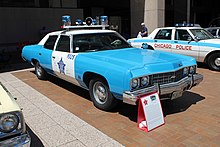
Almost other changes to the Bel Air during its last years were identical to the more expensive Caprice and Impala lines, some of which were mandated by regime safety regulations in the U.S. that included five mph (8.0 km/h) front bumpers in 1973 and similar-designed rear bumpers in 1974. The 1975 models had a new roofline and (along with the Impala) grille that was a direct re-create of the 1974 Caprice front end. Inside, in that location were new instrument cluster markings, radio and climate control graphics (the speedometer read upward to 100 mph (160 km/h), and had smaller numbers for kilometers per hour). Customers could buy their 1975 Bel Air with two new options: an Econominder gauge parcel (which included a approximate that monitored fuel economic system, due in part to growing demands for fuel economy as well as a temperature judge) and intermittent wipers.
In 1975, Consumer Reports tested a Bel Air iv-door sedan with the 350 V8 engine and Turbo Hydramatic against other U.S.-congenital full-sized cars of that period including the Pontiac Catalina, Ford LTD and Plymouth Gran Fury. Although the motorcar performed well in its tests and placed second to the Pontiac, Consumer Reports pointed out the Bel-Air had less racket insulation and a less-comfortable rear seat than its higher-priced siblings, and that a comparably equipped Chevrolet Impala (with boosted sound insulation, and upgraded upholstery and seat padding, a $203 premium over the Bel-Air) "would exist even closer to the Pontiac in overall quality." Even so, the magazine stated that—for case—the Bel-Air was "merely slightly noisier than the Pontiac". Consumer Reports concluded in its report that prospective buyers should pay the extra $200 or so to upgrade to the costlier Impala, noting advantages such as greater resale value and interior-outside appointments more comparable to the other tested full-sized vehicles.[29]
The final Bel Airs for the U.S. were manufactured for 1975. For 1976, a lower-trimmed Impala "South" iv-door sedan was a one-yr offering which had less standard equipment than regular Impalas and functioned as a replacement for the Bel Air.
Canada-merely models [edit]
Bel Air-based Pontiacs [edit]
From 1954 through 1969, GM Canada produced a unique Bel Air-based Pontiac marketed as the Laurentian. While torso panels resembled contemporary U.Southward. Pontiacs, the Canadian Pontiac Laurentian had the chassis, power train, wheelbase, even the interior (except for the musical instrument panel), of the Chevrolet Bel Air. These models were exported in SKD kit class in mill correct mitt drive to right hand drive markets, such as Australia, New Zealand, and South Africa, and locally assembled under the Pontiac marque. All RHD export ceased after 1968 at the behest of GM in the United states of america.[thirty]
Early generations (1970–1976) [edit]
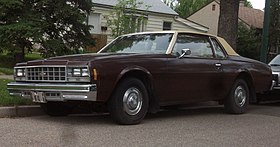
While the last Bel Air two-door sedan was available in the The states in 1969, Chevrolet introduced a Canadian market place-only two door hardtop, the Bel Air Sport Coupe, from 1970 to 1975. Based on the Impala Sport Coupe, this new model featured Bel Air trim at a lower price than the Impala. Each year through 1975, this model's body followed the pattern of the contemporary Impala Sport Coupe. The 4-door sedan and station wagon continued in production, identical to the U.S. models. For 1976, the Canadian Bel Air Coupe featured the same body as the Impala Custom Coupe, with the big stock-still rear quarter window and frameless front door glass.
Unlike the United States, all 1976 Canadian total size Chevys (including the Bel Air) came with steel belted radial tires and an electric rear window defroster as standard equipment.
Although the last Bel Air was produced in 1975 in the U.S., the Canadian big Chevy lineup connected to include the Bel Air for 1976 and beyond in two door, four door and station wagon trunk styles. The U.S. 1976 Impala line included an "S" model line, consisting of a 4-door sedan, to function as the Bel Air'due south replacement.
Eighth generation (1977–1981) [edit]
| 8th generation | |
|---|---|
 A 1977 Bel Air coupe in Canada | |
| Overview | |
| Production | 1976–1981 |
| Model years | 1977–1981 |
| Assembly | (main constitute) Flint, Michigan (Flint Assembly) (branch assembly) Baltimore, Maryland (Baltimore Assembly) Oshawa, Ontario, Canada (Oshawa Auto Associates) |
| Torso and chassis | |
| Trunk manner | 2-door coupe iv-door sedan 4-door station wagon |
| Platform | B-torso |
| Related | Chevrolet Impala Chevrolet Caprice Pontiac Laurentian Pontiac Parisienne |
| Powertrain | |
| Engine | 250 cu in (iv.1 L) Turbo-Thrift I6 305 cu in (v.0 50) Small-Block V8 400 cu in (vi.6 L) Small-Block V8 |
| Manual | 3-speed Turbo-Hydramatic automobile. |
| Dimensions | |
| Wheelbase | 116 in (ii,900 mm) |
In Canada, Chevrolet retained the Bel Air as its lowest-priced full-size car through the 1981 model twelvemonth. For 1977, Canadian Bel Airs received the aforementioned downsizing equally their Impala/Caprice counterparts in the U.Due south. Body styles offered during this flow were a four-door sedan, ii-door coupe and station wagon. Reflecting the smaller size of these downsized large cars was a lineup of generally smaller engines for improved fuel economic system with Chevy'south 250 cubic-inch six-cylinder reinstated as standard power in sedans for the starting time fourth dimension since 1973, with the 140 hp (100 kW) 305 V8 available equally an option in sedans and standard on wagons. The 170 hp (130 kW) 350 V8, bachelor in both models, was at present the top pick as the larger 400 small cake and 454 large block V8s were no longer available. Standard equipment on Bel Airs during this period included pocket-size hubcaps, fabric-and-vinyl upholstery in sedans or all-vinyl in wagons, cigarette lighter, ashtray, automated dome lite for front doors, full carpeting, Astro Ventilation, Delco Liberty battery, variable-ratio ability steering, power front disc brakes and Turbo Hydramatic automatic transmission. Dissimilar most previous model years and torso styles where just two taillights were used per side, the Bel Air shared the Impala'southward rear end triple-taillight setup.
The 1980 Bel Air along with other full-size Chevrolets, was revised with all-new exterior sail metal, which helped improve aerodynamics and thus fuel economy; the car was as well fitted with a new grille, identical to that of the higher-priced Impala; the rear-terminate triple-taillight setup also connected to be shared with the Impala. Besides that year, the engine lineup was revised with the inline vi replaced by a new three.eight-liter or 229 cubic-inch V6 based on the pocket-size-block V8 as the base engine in sedans. The new base of operations V8 (standard on wagons, optional on sedans) was a smaller 267 cubic-inch small-block with two-butt carburetor, while the 305 minor-block (optional on all models) got a 15 hp (xi kW) increase to 155 hp (116 kW) thank you to the change from a 2-barrel to four-barrel carburetor. The 350 V8 was now restricted to police-option vehicles. Another new selection for 1980-81 was the Oldsmobile-congenital 350 Diesel.
With a dramatic downturn in full-size auto sales, the Bel Air was dropped after the 1981 model year, as were a number of other low-trim full size cars in the Canadian market place including the Pontiac Laurentian, Mercury Marquis Meteor, and the Ford LTD Custom 500.
2002 concept [edit]
| 2002 Bel Air Concept | |
|---|---|
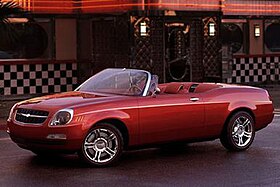 2002 Chevrolet Bel Air Concept | |
| Body and chassis | |
| Body way | 2-door convertible |
| Powertrain | |
| Engine | three.5 L (214 cu in) L52 I5 |
| Manual | 4-speed 4L60-East automatic |
| Dimensions | |
| Wheelbase | 111 in (2,819 mm)[31] |
| Length | 191 in (iv,851 mm) |
In 2002, a concept Bel Air convertible was shown at the North American International Auto Show. It features a few styling and blueprint cues from the all-time remembered tri-v (1955–57) models, such as the chrome windshield frame, traffic lite viewfinder, and a gas filler cap behind the tail calorie-free, similar to 1956–1957 Chevy'south gas cap backside the chrome trim on the dorsum of the tail fin, but more than reminiscent of the 1948–1958 Cadillac gas cap tail low-cal. Information technology also features the aforementioned body on frame hydroforming applied science (used in the frame rails of the Corvette and GM's midsize sport-utility vehicles) and a sheet metal torso, on a 111 in (two,800 mm) wheelbase, and a 65 in (1,700 mm) track. Pause is short long arm upwards front and Hotchkiss drive in the rear. It rides on five-spoke aluminum wheels with 18 in (46 cm) cherry line tires and anti lock discs all-round. The elegant, withal uncomplicated interior features a twin-element instrument panel, cavalcade-mounted gearshift and bench seats covered in soft high-tech fabrics colored red to match the outside that are cleverly designed to slide frontward for easier backseat entry. It also served every bit a showcase for their new turbocharged inline 5-cylinder concept engine based on the L52 (Vortec 3500), straight-v truck engine. Co-ordinate to a September 2002 GM press release, the all-aluminum three.5 L (211 cu in) 20-valve DOHC engine, with a bore of 93.0 mm (3.66 in), and a stroke of 102.0 mm (iv.02 in), that delivers up to 315 hp (235 kW) and 315 lb⋅ft (427 N⋅1000) of torque, mated to a Hydra-Matic 4L60-E electronically controlled four-speed automatic. A virtual "turbo boost" push button on the steering wheel activates the powertrain command module to trigger a more than aggressive spark and fueling calibration for maximum horsepower. It too led the 13th Annual Stater Brothers Route 66 Rendezvous equally the official vehicle in September 2002. General Motors has shown no involvement in producing the car.[32] In 2006, it was spotted stripped down in a GM parking lot.[33]
Elevate racing [edit]
Of noteworthy importance is the 1962 Bel Air Sport Coupe, the final twelvemonth a Bel Air pillarless hardtop was available in the US. This model featured the "bubbletop" roof from 1961 rather than the 1962 Impala Sport Coupe's more upright roof, and was popular with drag racers who ordered the car with the new-for-'61 409 cubic inch "W-cake" V8 with upwardly to 409 bhp (305 kW); a special bundle including aluminum body panels, heater delete, and four-speed manual transmission. A car with this configuration is a valuable collector vehicle that commands a big premium over other 1962 models including the Super Sport.
Australian Bel Airs [edit]
During the 1960s, Bel Air sedans were available in consign markets such as Australia, where they featured right-hand drive. Due to Australian regulations requiring amber rear turn signal lamps, these Bel Air sedans featured Impala-manner triple taillights during the 1960s. The center lamp was the amber turn signal lamp and the innermost lights were backup lamps. Most of these RHD Bel Airs used a 1961 Pontiac instrument console.
Run across also [edit]
- Chevrolet
- 55 Chevy
- 57 Chevy
- Chevrolet Nomad
- Chevrolet 150
- Chevrolet 210
- Tri-Five
- 1950s' American automobile civilisation
References [edit]
- ^ a b c d e f grand h i j k l m Flory, Jr., J. "Kelly" (2008). American Cars, 1946–1959 Every Model Every Twelvemonth. McFarland & Company, Inc., Publishers. ISBN978-0-7864-3229-5.
- ^ a b "Directory Alphabetize: Chevrolet/1951_Chevrolet/1951_Chevrolet_Foldout". Oldcarbrochures.com. Retrieved 2011-11-20 .
- ^ "Directory Index: Chevrolet/1952_Chevrolet/1952_Chevrolet_Specs". Oldcarbrochures.com. Retrieved 2011-11-xx .
- ^ 60 years of Chevrolet by George H. Dammann
- ^ "Directory Index: Chevrolet/1953_Chevrolet/1953_Chevrolet_Brochure". Oldcarbrochures.com. Retrieved 2011-11-20 .
- ^ "The Owners Report on the 53 Chevrolet". Popular Mechanics. Hearst Magazines. July 1953. Retrieved five March 2020.
- ^ "Gm En Venezuela Y El Mundo - Historia". Gm.com.ve. Archived from the original on 2010-03-23. Retrieved 2010-09-30 .
- ^ "1956 Chevrolet (U.South.) Bel Air 2-Door Sedan performance data, specs & photograph". Automobile-catalog.com. Retrieved 2011-11-xx .
- ^ a b Gunnell, John A., ed. (1982). Standard Catalog of American Cars 1946–1975. krause. ISBN0-87341-027-0.
- ^ a b c Consumer Guide Chevrolet 1955–1957. Publications International. 1991. ISBN1-56173-311-3.
- ^ "Pop Mechanics". google.com. Hearst Magazines. March 1955.
- ^ "Directory Alphabetize: Chevrolet/1955_Chevrolet/1955_Chevrolet_Prestige_Brochure". Oldcarbrochures.com. Retrieved 2012-05-23 .
- ^ a b 1634–1699: McCusker, J. J. (1997). How Much Is That in Real Money? A Historical Price Index for Use as a Deflator of Money Values in the Economy of the United States: Addenda et Corrigenda (PDF). American Antique Society. 1700–1799: McCusker, J. J. (1992). How Much Is That in Existent Money? A Historical Price Index for Utilise every bit a Deflator of Coin Values in the Economic system of the United States (PDF). American Antiquarian Gild. 1800–present: Federal Reserve Depository financial institution of Minneapolis. "Consumer Price Alphabetize (estimate) 1800–". Retrieved Jan 1, 2020.
- ^ "Directory Index: Chevrolet/1956_Chevrolet/1956_Chevrolet_Accessories". Oldcarbrochures.com . Retrieved 2012-05-23 .
- ^ Flory, Jr., J. "Kelly" (2008). American Cars, 1946-1959 Every Model Every Year. McFarland & Company, Inc., Publishers. ISBN978-0-7864-3229-5.
- ^ "1957 Chevrolet Bel Air Sport Coupe 283 V-eight Corvette Ramjet FI 283-HP close-ratio". motorcar-catalog.com . Retrieved June 19, 2018.
- ^ Paul Niedermeyer, ed. (June 15, 2016). "1957 Chevrolet Fuel-Injected 283 V8 – Alee Of Its Time And The Competition". curbsideclassic.com . Retrieved June nineteen, 2018.
- ^ "1957 Chevrolet Bel Air". myclassicgarage.com . Retrieved June 19, 2018.
- ^ Edsall, Larry (eleven December 2014). "What's and then special about the '57 Chevy (part 2)". The ClassicCars.com Periodical . Retrieved eight Nov 2018.
- ^ "Directory Alphabetize: Chevrolet/1956_Chevrolet/1956_Chevrolet_Owners_Manual". Oldcarbrochures.com . Retrieved 2011-11-twenty .
- ^ "Directory Alphabetize: Chevrolet/1957_Chevrolet/1957_Chevrolet_Owners_Manual". Oldcarbrochures.com . Retrieved 2011-eleven-20 .
- ^ "Pop Mechanics". Hearst Magazines. January 1958.
- ^ "Directory Index: Chevrolet/1958_Chevrolet/1958_Chevrolet_Owners_Manual". Oldcarbrochures.com . Retrieved 2011-11-20 .
- ^ "Directory Index: Chevrolet/1958_Chevrolet/1958_Chevrolet_Owners_Manual". Oldcarbrochures.com . Retrieved 2011-11-twenty .
- ^ "Directory Index: Chevrolet/1958_Chevrolet/1958_Chevrolet_Wagons". Oldcarbrochures.com . Retrieved 2011-11-twenty .
- ^ "Directory Alphabetize: Chevrolet/1959_Chevrolet/1959_Chevrolet_Brochure". Oldcarbrochures.com . Retrieved 2011-11-20 .
- ^ "Directory Index: Chevrolet/1959_Chevrolet/1959_Chevrolet_Owners_Manual". oldcarbrochures.com.
- ^ Usa Department of Transportation National Highway Traffic Safety Assistants (Jan 1, 1968). "Title 49 of the United States Code, Chapter 301, Motor Vehicle Safety Standard No. 208 - Occupant Crash Protection Passenger Cars".
- ^ "Full-Sized Sedans: Pontiac, Chevrolet, Plymouth, Ford", Consumer Reports, Feb 1975, pg. 103
- ^ "Australian Story".
- ^ Newbury, Stepehn (2002). The car design yearbook 1. Merrell Publishers Express. ISBNane-85894-190-3.
- ^ 2002 GM press release
- ^ McCausland, Evan (2006-06-08), 2002 Chevrolet Bel Air Concept , retrieved 2021-08-01
- Gunnell, John, ed. (1987). The Standard Catalog of American Cars 1946–1975. Kraus Publications. ISBN0-87341-096-3.
- Biel, John (2005), "A Glass One-half Full: The Story of the 1958 Chevrolet", Collectible Automobile, 21 (six): viii–23, archived from the original on 2006-02-thirteen
External links [edit]
- Chevrolet Bel Air
- Chevy Bel Air
Source: https://en.wikipedia.org/wiki/Chevrolet_Bel_Air

Posting Komentar untuk "Get a 1956 Chevy Belair Running Again"